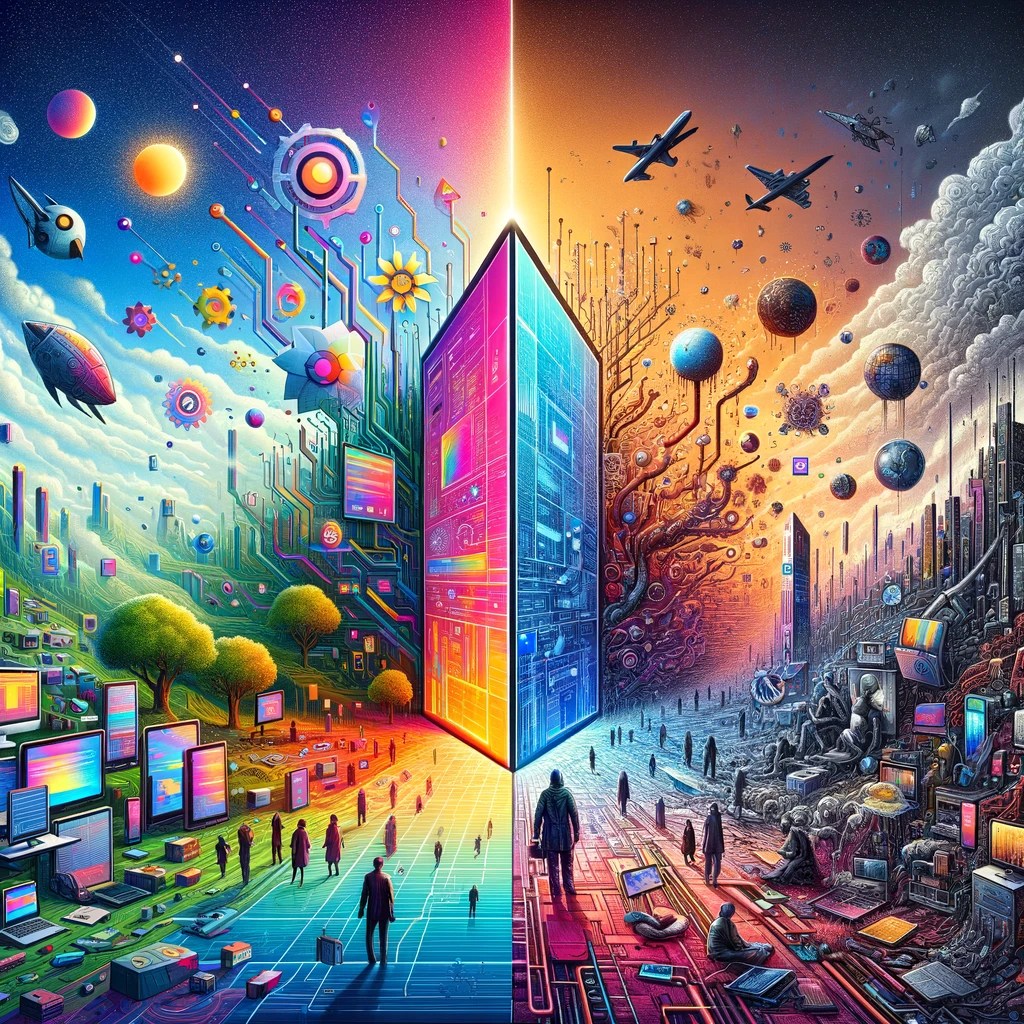
In 2023, the world of online technology has truly changed. In around a decade, the landscape has really shifted from one of techno-optimism to one of profit-grabbing and “enshittification” according to Cory Doctorow.
Reddit is trying to charge outrageous sums to 3rd-party app developers to use their APIs and doesn’t let you hide offensive ads anymore or voice your displeasure towards them.

Twitter has fired many of its content moderation teams, is squeezing the MTA and other public transit agencies for money for verified accounts, and is having more frequent outages than ever before.
Facebook is doubling down on the Metaverse, or maybe AI, or whatever they think is coming next really. My feed is full of ads and content I don’t care to see and all of my “friends” no longer seem to use it.
What happened?
We are clearly no longer in the swinging times dramatized in movies like The Social Network, where we can all “move fast and break things” and change the world with technology! According to Cory Doctorow, we’ve instead entered a period of “Enshittification”, where the platforms we loved and trusted have been taken over by corporate interests that no longer care what the users want or need.
The wonder and magic of software engineering have kept me in the industry for over a decade now and I’ve been playing with computers since I was a young boy. I’ve always found it enchanting to type some lines of code, add a DNS record or two, and a few clicks later be sharing a new idea with the world.
Living at the end of another economic cycle, where the money supply is tightening up and downstream effects on venture capital and the technology industry are becoming abundantly clear is kind of depressing to see given that I built my career in web software engineering. 5 – 8 years ago, we were in a different time, of Software being a magical thing to the whole world and not just engineers. At least it felt like that. Now most people look at the Reddits, Twitters, and Facebooks of the world with derision and skepticism.
Are there any potential solutions to where we are now that are closer to the perfect technological utopia we all strive for?
Making software a publicly run utility
The ease of requesting a taxi with a few taps is amazing. Why don’t governments build an open platform for taxi operators to offer their taxis to consumers, and consumers to request them, that could be easily integrated with by both sides of this market?
Well, we’re all familiar with well-intentioned government initiatives in technology that are wildly expensive, poorly run, or a combination of both. There’s of course the 18Fs and USDS’ of the world that do an amazing job deploying public technology, but they tend to be the exception and not the rule. An effort to make any software a publicly run utility will have to overcome this skepticism and also be run well enough for both sides of a two-sided market to work well enough for everyone to buy into it.
Cities might make their own taxi federation network, or states, or countries. The taxi federation network in the US might be totally different than that in Europe, crushing the feeling of ease you get when stepping out of an airport in either place at getting a cab with an Uber or Lyft. Cooperation between global governments on technology standards is scattershot at best. Just look at the EU’s embrace of CCS technology and the US’s Ford Motor Company now embracing the Tesla charging standard instead.
Any such publicly run federated networks will also have to compete with the Ubers and Lyfts of the world, the privately-funded firms, to be successful. These firms can pay Software Engineers and their other employees much more than the government, and offer them the opportunity to enrich themselves through stock options, and so the cycle continues: raise money on a big idea, attract users to both sides of a market, cash out, and we’re back to enshittification again.
This doesn’t even account for how dysfunctional the US government is federally. We can’t get two parties to agree on almost anything and whenever an expert from a tech company is brought in, Senators often conflate two firms or ask irrelevant questions that make no sense. We’re not like Estonia with its digital society.
In movies and TV shows about the future, we see someone turn on their television, ask it to play the media they want, then see it magically start playing. The world most media consumers live in makes you first find the service or app the movie is on, figure out its peculiar interface, find the film and not any cheap knockoffs or imitations, perhaps think about how to pay for it, then play it (which is why I love Roku’s universal search interface so much, but I digress). This competition is supposedly good for capitalism, at the expense of user experience. Uber was great when it first came out because it was the taxi app, but that same monopolistic behavior and growth led to its downfall.
Some folks on one side of the political spectrum are against monopolistic behaviors like this. Others might not like the government creating a competitor to private industry even if it was meant to be a tide that lifted all ships.
A governmental effort to create an open competitor to the Ubers of the world, or encourage federation of users and service providers in any industry, has much to overcome to actually be successful.
Making Software something that people can run on their own without “corporations“
The federated solutions of the world like Mastodon and the ActivityPub protocol it runs on offer one possible cure. Why not have everyone contribute computing power and system administration time, then use the power of networks to connect their applications together? We can all get a Rasperry Pi micro computer and some open source software free from the web and run our own services!
This is a noble idea, but the practical application of it is exceedingly difficult with today’s technology and the level of technological literacy of the average citizen. Try telling most people how website hosting works, and how a server is basically just a computer in the cloud running some software, and their eyes glaze over pretty fast.
Enthusiasts love running their own Mastodon servers but let’s be honest, they’re a very small portion of the actual population. Not only that, but a network and applications built on it need a certain amount of critical mass to make adoption worth it. Mastodon is probably the closest thing I’ve seen to this happening, but it feels that most of the passion behind it is in response to the vitriol after the Twitter acquisition, and less about having a solution that’s so easy and fun to use that everyone wants it. That seemed to be the key to mass adoption of the services this article started with.
Why don’t we have more and easier solutions for federated applications and software? Well, Software Engineering is expensive, and so is Hardware/Firmware Engineering, not to mention Logistics and Manufacturing. Chips may be relatively cheap to make in bulk, but assembling the right ones together, manufacturing them at scale, building software for them, and then finally building the crowning network of users that brings it all together is incredibly difficult. You can just deploy your whole application in the cloud, but that costs money.
That’s why the most successful enterprises have been capitalistic, with a profit motive for their hard-working founders and engineers. Unfortunately, this profit motive also leads to the enshittification we’ve been discussing eventually, it seems hard to avoid that happening at some point.
Create a new economy with micropayments and/or digital currency based incentives
This is an approach that we’ve seen rise and fall over the last 5 – 7 years: cryptocurrency as the perfect road to digital utopia. Maybe some of the approaches are still working or gaining steam, like the Brave browser’s Basic Attention Token (BAT), but cryptoskepticism and disenchantment is quickly eroding any gains that were made. This is also tied to the world economy and interest rates, as much as crypto zealots would hate to say that the two things have any bearing on each other, the bottom fell out of crypto around the same time interest rates started rising.
Still, if we can imagine a world where this worked out, maybe you don’t want to run your own Mastodon instance but you’re also ok either A) paying a sysadmin type to run one for you with some kind of micropayment or B) seeing some ads to pay that sysadmin type to run it for you, with the advertiser paying you in crypocurrency.
But then we sort of end up with the same problems and perverse incentives of the last solution with regular currency: eventually that sysadmin needs more help to run all of the servers under their control, they start a corporation that needs management help to be able to hire more sysadmins faster and more efficiently so they don’t have to do that “boring” work themselves, start combining the micropayments together to pay the new folks, then have to raise VC money to grow faster or bridge a rough period, then cash out. Enshittification happens all over again.
Or, and this is off the crypto route but worth exploring, they try to be a non-profit and tend to run out of money or steam over time, or bite off far more than they can chew and give up. Look at the Social Purpose hardware corporation Purism and this interview with their former CTO for an example of this. Hasn’t completely folded yet but they’re having a very hard time delivering on their promises. It doesn’t mean that open source or social purpose projects don’t work at all, but there seems to be a limit to how far they can go before they end up becoming a for-profit corporation, or at least require sponsorship from one.
The only thing different with crypto approaches seems to be the type of currency used to run the scheme and that you had an Initial Coin Offering and Airdrop instead of a Series A and Seed round. Not to mention that with the aforementioned cryptoskepticism, it’s probably even harder to follow this approach now and convince people it’s really any different. Sure, dealing in hard currency has its costs and gatekeepers, but does crypto save enough on those to make it worth it, and are crypto corporations any less susceptible to enshittification? Probably not.
Where does that leave us?
All of these ideas sort of come back to the same capitalistic problems that lead to enshittification: a good idea not only needs brilliant engineers, management, and employees to make it work technically, but also management, partnerships, seed money for manufacturing key elements, and everything else that leads to the capitalist, corporatist approach, that eventually leads to enshittification.
Everyone along the chain under a capitalistic system benefits, so why would they stop the flywheel? Maybe if the founders or controlling interest in these new ventures could escape the profit motive, it would be possible to do so, but usually raising money is predicated on the firm being worth more in the future, for that early stake to be sold at a hefty profit.
This is a sort of depressing solution, but another way to look at it is that the system is working. Sure, Reddit is being enshittified now, but it had something like a 12 or 15 year run making its users’ lives better and keeping me personally super entertained! Uber has been run into the ground, but there were a few years there where I got a ride in a magical way and some drivers did better financially than they ever have (however short-lived that was). A friend of mine also had this to say about Uber in particular after reading this post:
Uber is still doing fine. They reported $8 billion in revenue to Lyft’s ~$2 bill and haven’t laid off 1/3 of their staff like Lyft did. It’s just not the $60 bill gorilla it once was.
Twitter eventually was used to manipulate elections and is now being seemingly morphed into the next version of far-right platforms like Parler, but not before it helped enable the Arab spring and some crucial conversations on rights around the world to happen.
Looking at it this way, everything ends up enshittified, but maybe it can do some good along the way before it does, and that’s enough. Maybe we can also hold off the enshittification for a really long time, long enough for society to get a net benefit before it happens. That’s the magic of capitalism that my parents and grandparents saw could make the world a better place for them and their families, as much as it is hard for my liberal-leaning self to admit.
The best solutions at every price point are rewarded with cold hard cash, until it goes too far, and they collapse. Enshittification is a natural cycle, a natural part of capitalism, that then opens up the competitive landscape for new entrants. Over long time periods, and with enough entrepreneurial folks, the net benefit to society of all of these startups and businesses is good, or else we wouldn’t pay for them, right?
As a Software Engineer, with that seemingly magical power to summon functionality with a keystroke (that AI will surely replace in a number of years, like most other jobs 🙃), I can take joy in the years when companies’ solutions enthrall, delight, and serve their purpose, that I had even a small hand in helping along with software.
We all want to think we’re masters of logic and that our code and careers are as close to perfection as we can make them, “changing the world” to make it a better place permanently, but we’re really only human, and nothing we do will ever be perfect, or especially remain perfect forever. Just like the rise and fall of anything, of celebrities who inspired but are now on an endless drug bender, of empires that started as bastions of justice and liberty then became stalwarts of oppression and murder, and potato chip bags that used to be overflowing but are now filled with mostly air, software and novel technology firms are just like everything else in capitalism: they probably have an expiration date.
Even though the narrative the last few decades seems to have been that technology will save us all, and that once we implement the technological solutions we’ll be able to automate away all the tedium of life, it also succumbs to the most basic of human principles – nothing lasts forever, and something better will come along to replace it. But maybe that’s okay.
I’ll enjoy my days coding and helping users as best I can, but also leave time for the magic of the non-technological: warm sunny summer days, a BBQ with my family on a national holiday, and a road trip to a place slightly different than my own to open my eyes to new things.
Believing that enshittification has a solution is believing in a utopia that can’t really exist, where things remain perfect forever. I don’t think that’s a world that humans can ever really create. We can just strive to get closer and closer to it every day and be good to each other along the way.


 Constant Tinkerer V2.0
Leave a comment